

We have written a great deal on the evolution of U.S.-China relations, and we expect them to evolve further after the upcoming summit between Chinese President Xi Jinping and U.S. President Donald Trump. We have also written on the evolution of relations between Japan and Australia, driven in part by the U.S. and China. Last week, a significant event enhanced Japanese-Australian ties: The government in Canberra signed a deal to order 11 frigates from Japan. More, Australia announced recently the largest-ever increase in its defense budget, while Japan has dramatically increased its own defense budget.
Both of these developments are predicated on U.S. policies to reduce involvement in the Eastern Hemisphere. They are the same policies on which Washington’s efforts toward accommodation with China are based. Now that the U.S. has attacked Iran, it’s hard to see America’s presence in the Eastern Hemisphere declining. But, assuming it’s part of the process of disengagement, the attack is meant to eliminate the future need to be concerned with Iran’s nuclear capability. The basic principle of limiting U.S. entanglement in the Eastern Hemisphere adheres to the administration’s stated priorities in its National Security Strategy. While such publications are at times mere wish lists, there is evidence to suggest the U.S. is much more interested in the Western Hemisphere than the Eastern. Such are its geopolitical imperatives.
Given the increases in Japan’s and Australia’s defense budgets, not to mention their mutual defense cooperation, it seems as though these allies are taking the new U.S. policy seriously. A reduction in U.S. involvement puts both countries in similar circumstances: Both have the capacity to become militarily stronger, particularly as naval powers, and each has to some degree depended on the U.S. for its security needs. The Japan-Australia relationship, then, should be seen as a step toward the creation of a new geopolitical reality in the Western Pacific.
The geographic foundation of U.S. strategy in the region is what’s called the first island chain, a group of Pacific islands that includes Japan, Taiwan, the Philippines and Papua New Guinea and extends all the way to Australia. The first island chain establishes reliable but wide sea lanes through which ships from China’s east coast pass to reach the Pacific Ocean and, by extension, the foreign markets on which its export-oriented economy depends. These shipping lanes would also be crucial in times of war, especially with the U.S., because they can be easily blockaded or otherwise targeted, given the predictability of Chinese passage.
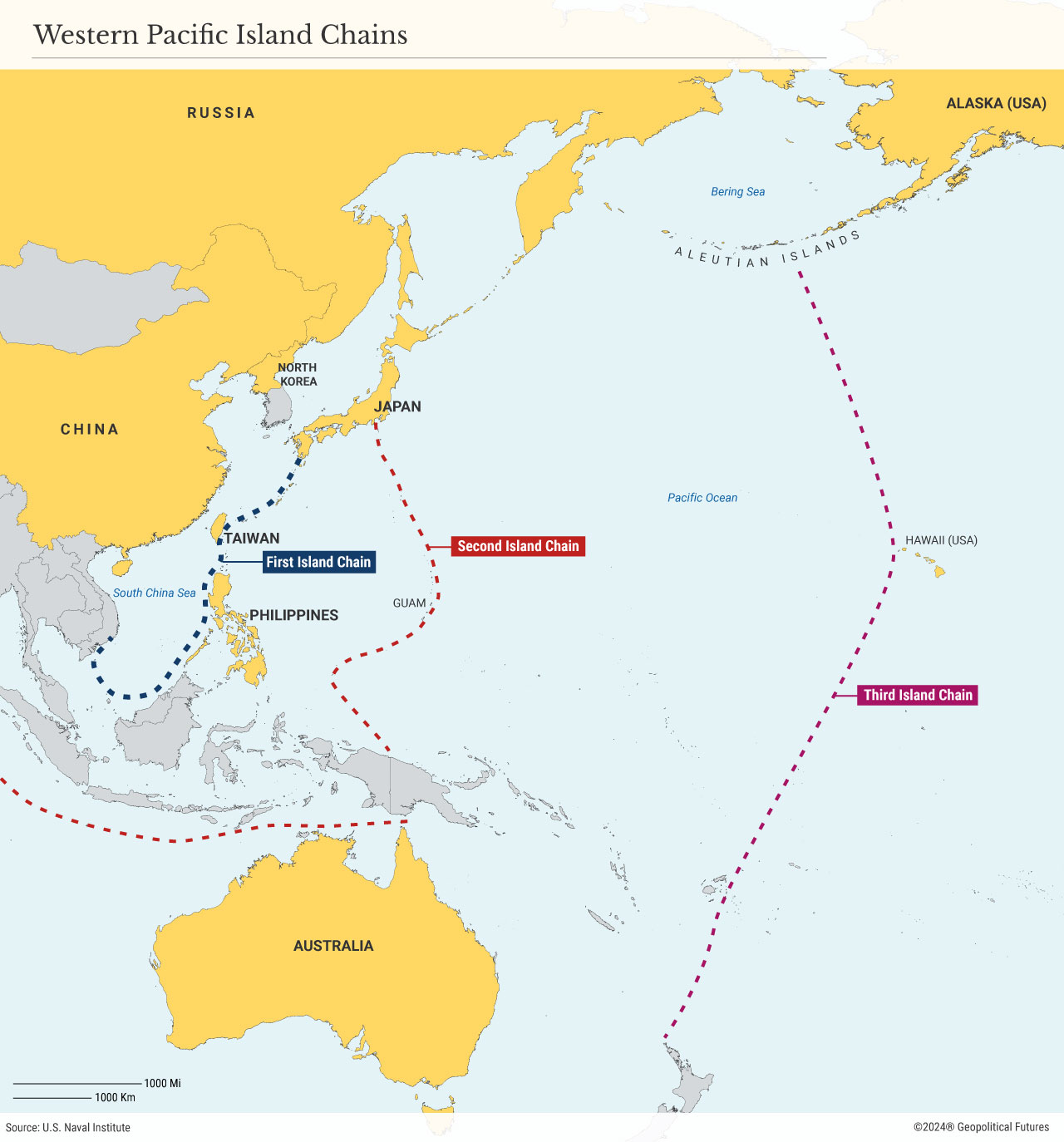
In negotiating with the U.S., one of China’s biggest sticking points is Taiwan, located between Japan and the Philippines. Considering that the U.S. has bases in both Japan and the Philippines, the neutralization of Taiwan would create a much larger passage to the Pacific and enhance Chinese national security. At the moment, it appears discussions on Taiwan are evolving, with the head of the growing opposition party in Taiwan visiting China earlier this month and expressing a desire for closer bilateral ties, increasing the probability of a U.S.-China accommodation. Meanwhile, Beijing continues to put military pressure on the Philippines. But Washington shows no inclination to neutralize the Philippines, since doing so would create a far greater breach in the barrier of the first island chain. The Philippine question will likely emerge in U.S.-China discussions. The U.S. will refuse to give in, and China will settle for a smaller opening, albeit with greater access to the U.S. market.
Given all this, Australia and Japan have an imperative to build up their militaries, and to do so in concert. The U.S. will maintain close ties with both, even as it delegates defensive responsibilities to them. Both are economically viable enough to handle the load.
It is in this context that the frigate deal between Japan and Australia should be considered. Japan and Australia see that the U.S. and China are interested in reducing military tensions and enhancing economic relations. Both are in a position to strengthen their ties, even though they might rationally prefer that the U.S. bear the burden of protecting them. This would constitute a significant alliance; Japan is evolving so that in the future it would have the ability to limit China’s access to the Pacific at the gap between its territory and South Korea’s, while Australia, with its increasing naval capability, will have the ability to block the Strait of Malacca. While neither is likely to try to do as much, given Chinese military capability, the possibility can never be ruled out. And in the age of drone warfare, new realities might be possible.
The bottom line is that the agreement between Australia and Japan gives a sense of the geopolitical realities emerging from a potential U.S.-China detente, and that both regional powers consider it likely. The issue of the Philippines and South Korea will be next. Assuming the U.S.-China summit goes well, a new Pacific order is emerging.


 The World Explained in Maps