

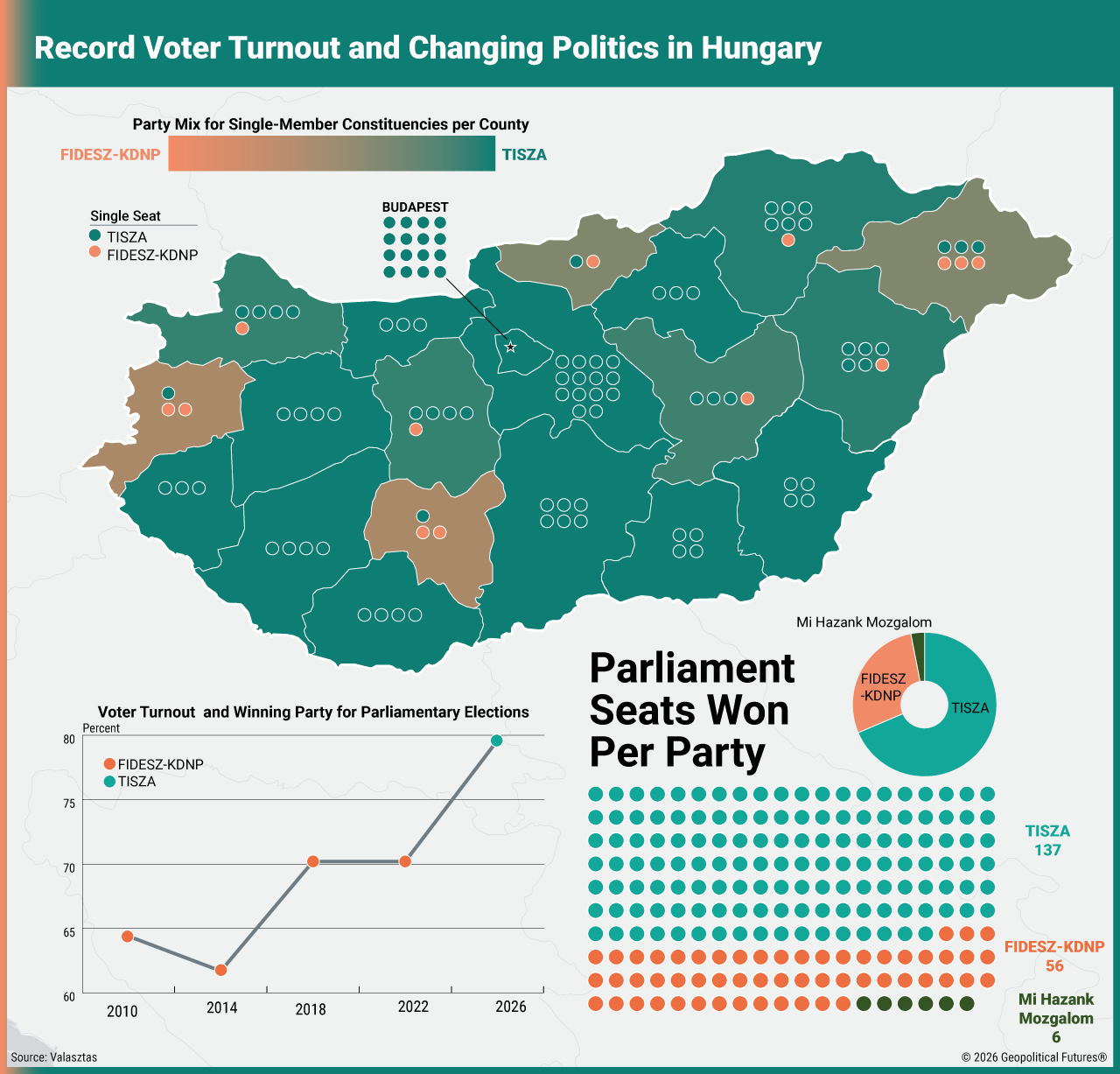
Parliamentary elections in Hungary on April 12 marked an end to the 16-year rule of Viktor Orban and his Fidesz party. Peter Magyar and the Tisza party claimed a landslide victory, winning 137 of 199 seats. The record-high turnout reflected a strong demand for change after a decade and a half of Fidesz political domination.
With a two-thirds majority in parliament, the new leadership could theoretically dismantle many of the changes introduced by Orban. It won’t be easy, however, as he made many institutional, not just political, reforms to embed loyal networks across the state apparatus. Hungary is therefore likely embarking on a long transition, in which incremental political adjustments will outstrip deeper, long-term institutional shifts. Economically, there’s a sense of optimism that improved relations with the European Union could finally unlock billions in frozen funds and stabilize markets. But here, too, the reality is more complicated. Even under the new government, constraints tied to geography, energy dependence and regional security won’t simply disappear. As a result, Hungary will most likely need to renegotiate its position within Europe while managing these enduring pressures.
For Europe, Orban’s loss eliminates a major obstacle, potentially enabling greater cohesion on issues such as support for Ukraine and rule-of-law enforcement. At the same time, it removes a convenient deterrent to real political reorganization: For years, Hungary’s obstructionism allowed other EU actors to avoid having to make deeper structural reforms. That dynamic will now shift, placing greater responsibility on pro-European governments to deliver tangible results. The election outcome weakens the symbolic center of Europe’s illiberal and populist movements, but it won’t abolish them completely. The political balance in Central Europe will now be reshaped – a process that could encourage either reform or a recalibration of similar forces elsewhere in the region.



 The World Explained in Maps