
Last week, U.S. President Donald Trump met in Washington with the leaders of Kazakhstan, Tajikistan, Kyrgyzstan, Turkmenistan and Uzbekistan – all former members of the Soviet Union before it collapsed. Post-Soviet relations with these nations are varied and complex, but all of them generally maintain economic and military ties to Moscow.
To understand the context of the Washington meeting, you need to understand what has happened in the Caucasus region. The South Caucasus consists of Armenia, Georgia and Azerbaijan – also former Soviet states. The relationships between these countries and Russia and among themselves have ranged from hostility and warfare to accommodation. Armenia and Azerbaijan fought a number of wars against each other over control of the Nagorno-Karabakh region, and Russia invaded Georgia in 2008 over its ambitions to join NATO. And though Georgia still has no diplomatic relations with Russia, it keeps important economic and political relations with it.
North of the Caucasus Mountains is a string of countries that are still part of Russia, even though some (Chechnya) fought for independence. To a great extent, Moscow has pacified the North Caucasus, thereby creating a buffer between it and the South Caucasus. In years past, the Soviet Union’s ability to control both sides of the Caucasus – itself largely a buffer against a historic adversary and NATO member in Turkey – also limited any threat to Russia from the south.
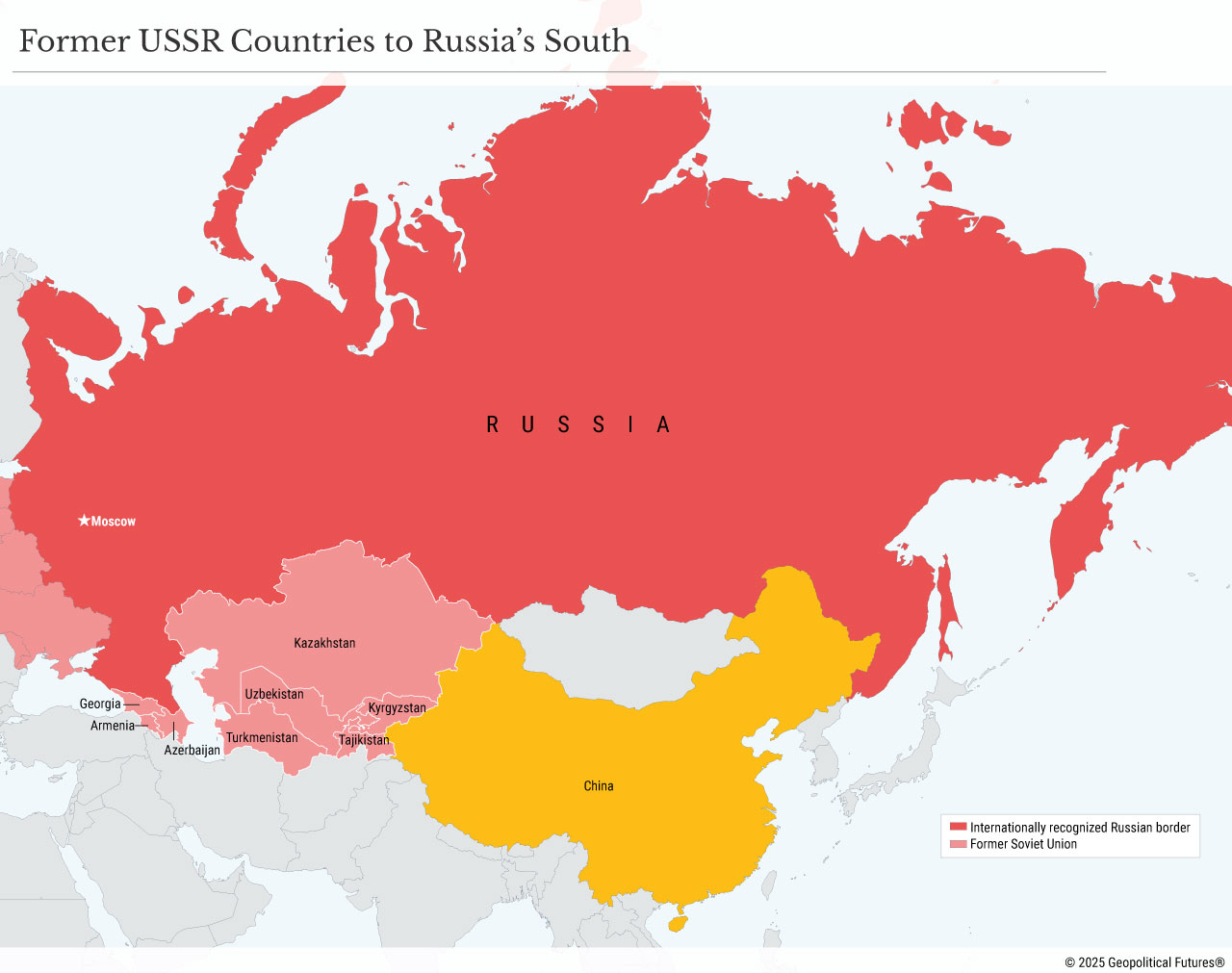
The countries of the South Caucasus are now broadly allied with the United States, particularly on economic matters. (The threat posed by Turkey is muted somewhat by its hostility to Armenia, while Georgia has a much more complicated foreign policy with both Russia and the West.) Over the past year or so, a development project has emerged. Known as the Trump Route for International Peace and Prosperity, it will link Armenia and Azerbaijan – a major oil producer – and was made possible only by the conclusion of the Nagorno-Karabakh conflict. The route is, crucially, a big problem for Iran.
In other words, the South Caucasus has ceased to be a Russian buffer and has become a U.S. ally, albeit an informal one. And now, the U.S. is courting Central Asia. While Russia was busy tending to its western border with Ukraine, its south and southeastern borders have become less secure. Neither of these areas has seen U.S. military deployments, but Russia cannot dismiss this possibility.
Meanwhile, there has been an interesting evolution on Russia’s southeastern border with China. After Trump met with Chinese President Xi Jinping, the U.S. asked China to stop importing Russian oil; two major Chinese importers agreed to do so. This was at least a partial attempt by Beijing to open better relations with Washington without formally being hostile to Moscow. Now, Russia and China have been hostile plenty of times throughout their history. They were even at odds during the Cold War despite both being communist nations. China did not vote against the U.N. resolution condemning Russia’s invasion of Ukraine, instead choosing to abstain, nor did it send troops to support Russia. (It did allow Russia to buy its weapons, however.) At the same time, the government in Beijing has been issuing maps depicting areas of eastern Russia – including Vladivostok, which was seized by Russia in the 19th century – as part of China.
China’s willingness to stop companies from buying Russian oil should be seen as a gesture of goodwill ahead of hopefully better relations with Washington. This makes sense because the Chinese economy needs access to U.S. markets. China is undergoing significant economic problems, including potentially declining exports, a real estate crisis and high unemployment in certain population segments. Should China decide the obvious – that if tensions result in massive tariffs, it will need better relations with the U.S. – it will probably spurn Russia, especially if there is little economic fallout in doing so.
All this is to say that Russia’s obsession with its western border has come at the expense of its southern border, the countries along which are interested in reaching an accommodation with the United States. Russia has neither the ability nor the interest to act on two borders at once. Normally, this would lead a nation to moderate attention to the war it is not winning and try to reduce future threats on the other borders. So far, this is not what Russia is doing.