
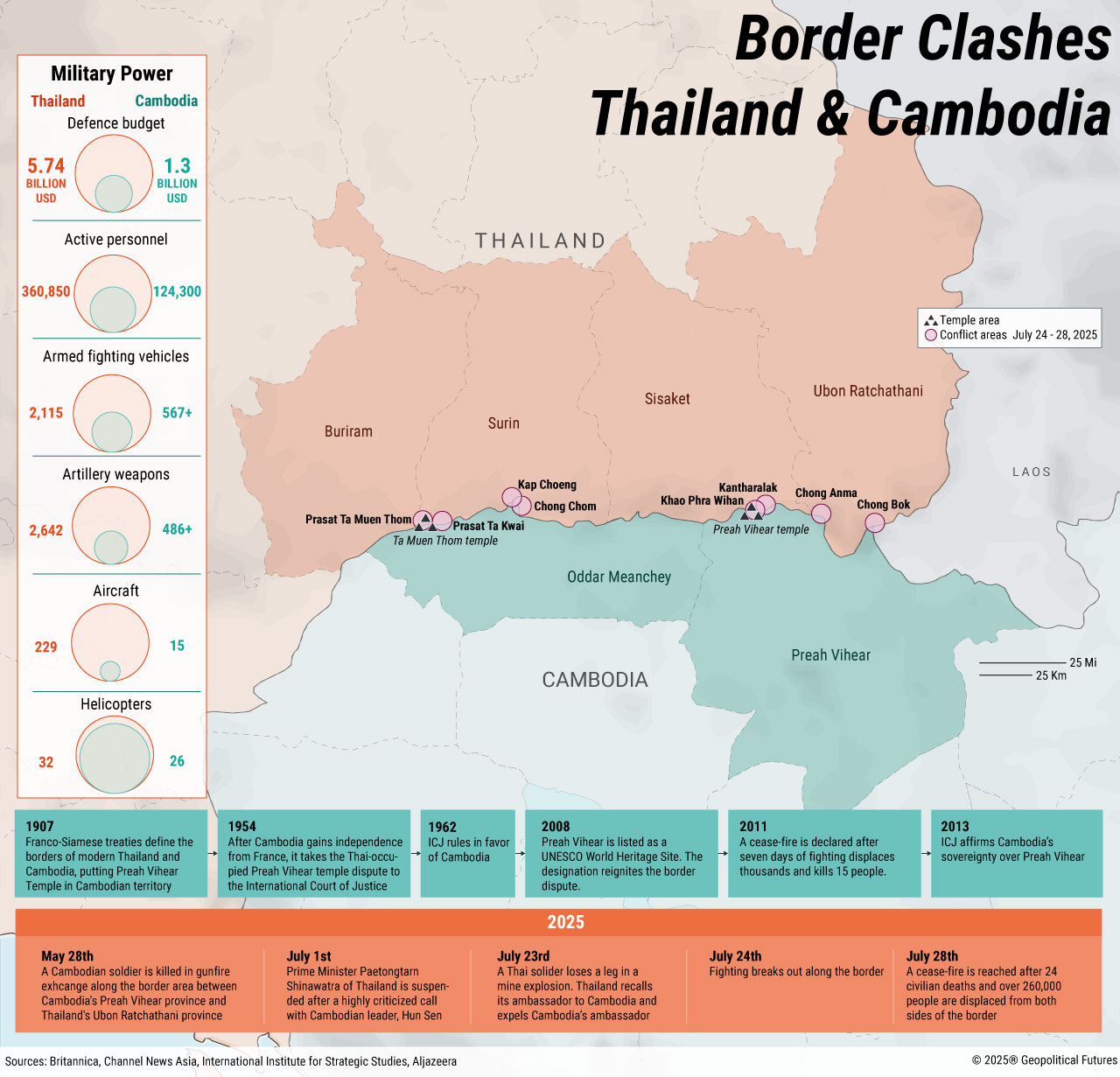
The Thailand–Cambodia border dispute over the Preah Vihear temple has flown under the radar but its nonetheless geopolitically significant. It stems from an interpretation of the border demarcation established during the French colonial era. Though the International Court of Justice awarded the temple to Cambodia, ownership of the surrounding area remained ambiguous, triggering periodic clashes well into the 21st century. The latest flare-up was triggered by a border skirmish near Preah Vihear on May 28, when soldiers exchanged fire and both sides. Several casualties were reported. Tensions rapidly escalated as Cambodia reinforced multiple positions, culminating in Tahi airstrikes on July 24, following what it characterized as cross-border rocket attacks on Thai civilians. An ASEAN-brokered ceasefire – mediated by Malaysia in its capacity as ASEAN chair, took effect on July 28.
The temple is located in a strategic, elevated position, one that enables monitoring and potential interdiction of key logistical routes. For Thailand, these include roads leading into the northeastern provinces and onward toward the Chao Phraya River Delta, its economic and agricultural heartland. For Cambodia, they include access points toward Siem Reap and Phnom Penh. In military terms, holding this terrain denies the other side an easy corridor through which it can penetrate deeper territory. The temple, then, is a matter of national defense.
Thailand has a more modern and capable armed forces, with a significant edge in air power, precision-guided munitions and integrated artillery support, as well as well-developed border infrastructure. Cambodia’s border infrastructure is less so, limiting its mobility and logistical endurance. But in recent years Phnom Penh has acquired upgraded artillery, multiple-launch rocket systems, and air-defense assets – all thanks to its support from China. Still, Cambodia lacks the airpower to match Thailand’s ability to project force and conduct sustained precision strikes.
Though the most recent fallout was likely triggered by rising nationalism on both sides – not to mention the fallout between Thailand’s powerful Shinawatra family and the clan of Cambodia’s former leader, Hun Sen, whose son is now the prime minister – the dispute transcends religious, cultural and territorial claims. Without a lasting resolution, the border remains a potential flashpoint where things could escalate quickly, drawing in broader political and possibly external interests.