
A battle is raging in Pokrovsk, located in the eastern Ukrainian region of Donetsk. It is part of Russia’s attempt to encircle Ukrainian forces stationed there. The intent is to take control of a strategic area near the Black Sea, outside the region that Russia occupied during the more stable phases of the war.
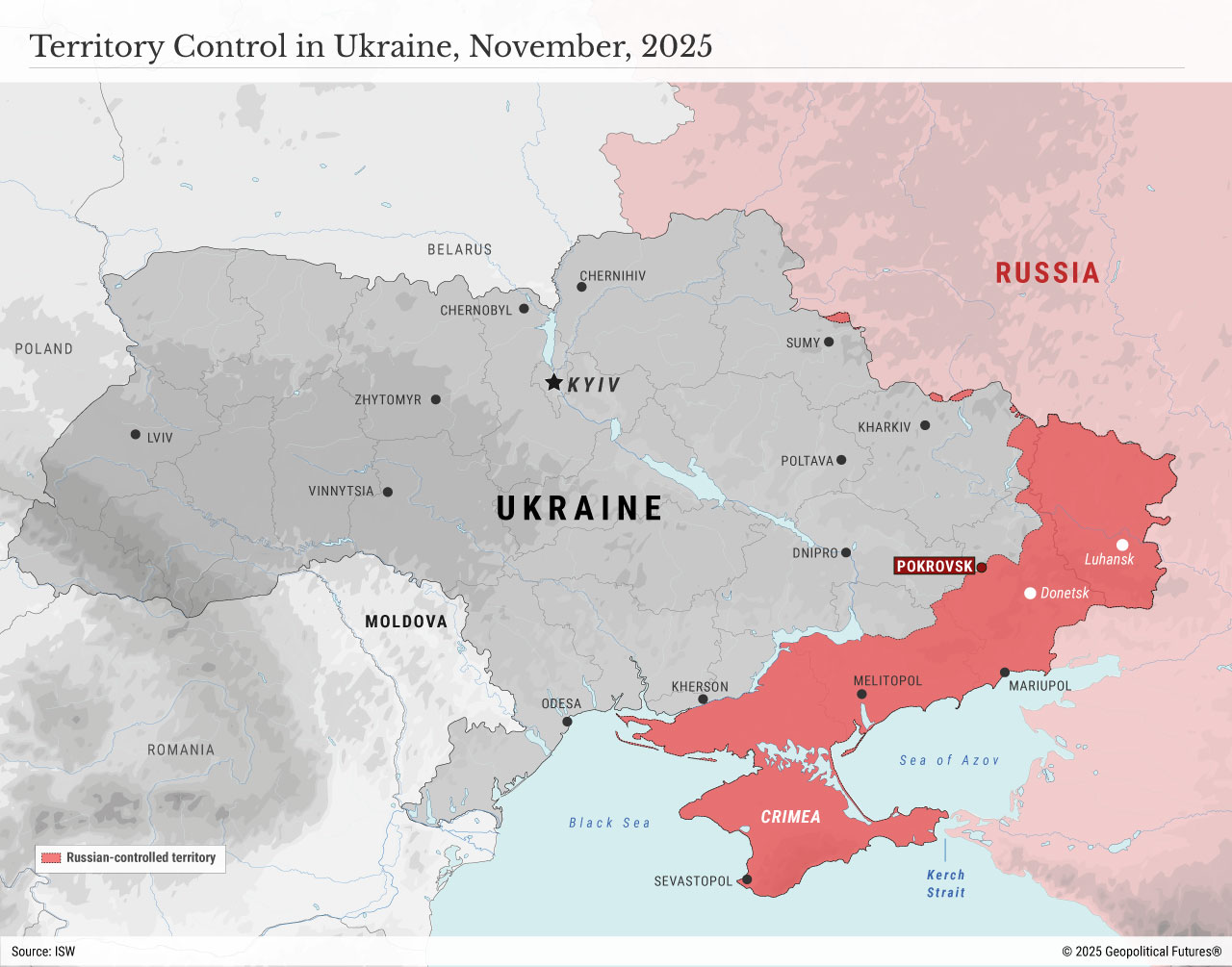
What’s more interesting than the strategy is the tactics Russia is employing – far different from what it has used in the past. The initial invasion in 2022 consisted of several separate and relatively narrow thrusts designed to achieve a rapid victory. One was meant to seize the capital of Kyiv, while the others were meant to penetrate central Ukraine. The strategy was designed to shatter and sever Ukrainian forces and, ultimately, occupy the country. Though the central thrust failed, the eastern thrust yielded the 20 percent or so of Ukraine that Russia had already occupied in recent years.
These failures forced Moscow to adopt a new strategy of massed forces in an attempt to overrun and destroy Ukrainian defenders along the front held by the eastern thrust. In other words, what began as rapid movement on multiple fronts became a battle of mass warfare that stalled in equal parts because of effective Ukrainian defenses, drone strikes against Russian forces and logistics problems that halted advances.
The battle that is now raging is different. The intent here is to systematically destroy Ukrainian forces in smaller, multiple engagements consisting of commensurately smaller forces.
The goal is not to break through Ukrainian forces but to disperse them. The operational logic is that Ukraine cannot absorb the casualties imposed in the smaller engagements due to the smaller size of its army. Moscow means to engage at close range, accept the casualties it has incurred, and inflict casualties on the Ukrainians. This is a tactic often used in wars of attrition. It is based on the strategic reality that Russia’s large army can take more losses than Ukraine’s can. A war fought on this basis becomes a matter of arithmetic.
Wars of attrition have as their foundation the mathematical ability of each side to absorb casualties and remain effective, with the larger force simply outlasting the smaller one. Such a war depends on three things. The first is the amount of time it takes for the larger force to break enemy defenses – that is, sucking into the battle forces to replace casualties at roughly the same rate. The second is the ability to supply multiple smaller engagements in a variety of areas. Given the high rate of casualties involved, it also depends on troop morale. Morale cannot be quantified, nor is it predictable in the long term. Russia is therefore betting that less ambitious engagements with smaller units that can metabolize large numbers of casualties will eventually break Ukrainian resistance.
The problem in this sort of warfare is that the defenders, in this case Ukrainians, will be better able to constantly retreat, giving them the advantage of reducing the length of their supply lines. The attackers’ supply lines are much longer, which amplifies normal supply issues and invites drone attacks. For Russia, then, the key to this strategy is to prevent Ukrainian forces from retreating and drawing the battle closer to reinforcement and resupply.
Assuming that Russian troops have the morale to accept the casualties and remain effective, and assuming logistic systems are in place to equip forces as they get farther away from supply hubs, the strategy might work. And given the failures of its earlier forays, this may well be the only path to victory – other than a peace agreement.
For Ukraine, the best strategy is to avoid encirclement, constantly moving closer to supply and reinforcement and drawing the Russians away from their bases, and to carry out this withdrawal at a fast enough rate to force a Russian logistics failure. In other words, appearing to be losing while preparing to engage at the point when Russian logistics fail and Russian troops are exhausted.
That’s the theory, anyway. Only sometimes do these strategies actually work. Russia has used up all its other options. Ukraine has the benefit of defending its homeland, so morale might be on its side. There is little glory but much blood in this type of warfare. Victory goes to whoever is least exhausted after a series of desperate engagements. It is an ugly ballet being carried out on one side by Russia, which has displayed an inflexibility in its supply lines and reinforcements, and on the other side by Ukraine, which has markedly fewer soldiers. (Russia’s use of mercenaries only compounds the issue.) With Europe and the United States unwilling to deploy forces, the price of admission is getting higher. But I would also argue that the ability of the Russian force to maintain this tempo of operations at distance from base is highly problematic. If Russia thinks the numbers are on its side, this might explain why President Vladimir Putin has yet to agree to a ceasefire or settlement. In my mind, it’s his last best move.



 The World Explained in Maps