

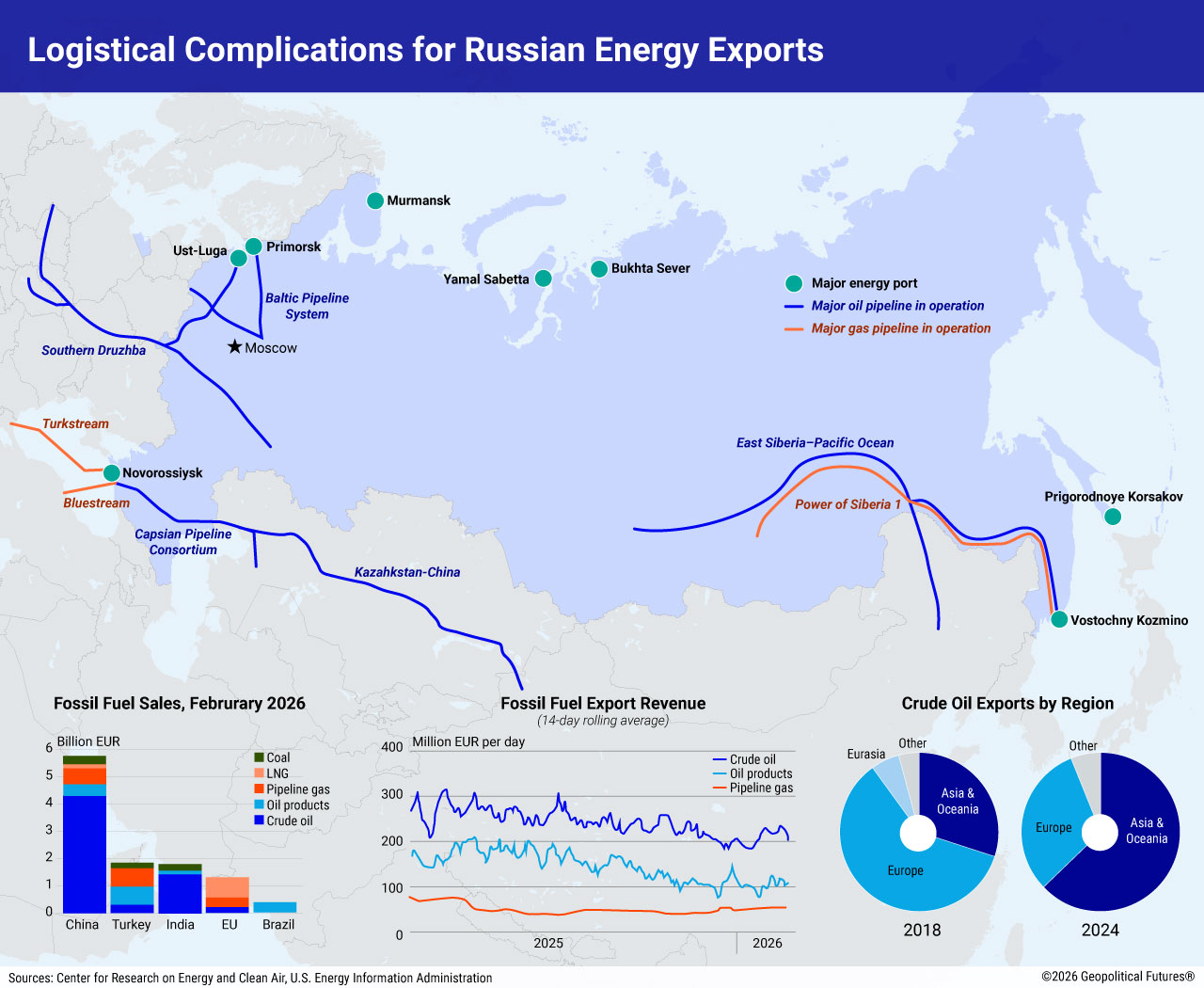
Against the backdrop of the war in the Middle East, sharply rising energy prices, and the temporary easing of U.S. sanctions on Russian oil, Russia’s oil export revenues have returned to growth after declining steadily over the past four years. This has lifted the Russian state budget, which, despite efforts at diversification, continues to receive a significant share of its revenue from oil production and sales. However, despite growing demand, particularly from Asia, the benefits may be short-lived. Starved of investment and Western technology, Russia has limited ability to sharply accelerate production.
Transport infrastructure is also a limiting factor. Russia primarily exports energy via pipelines or seaports. However, it cannot fully utilize its infrastructure in the western part of the country due to sanctions, existing damage and Ukrainian drone threats against terminals and tankers. Ukraine has recently intensified drone attacks on Russian oil and fuel export infrastructure, hitting all three of Russia’s largest western oil export ports (Novorossiysk on the Black Sea, Primorsk and Ust-Luga on the Baltic Sea). Part of the Druzhba pipeline was also damaged. To the east, the issue is a shortage of pipelines and terminals. Expansion is costly and time-consuming.
Therefore, the Russian government is not optimistic that rising energy prices will provide lasting benefits. Moscow expects this to be a brief respite, rather than the start of a full-fledged return and strengthening of Russia’s position in the energy market.