
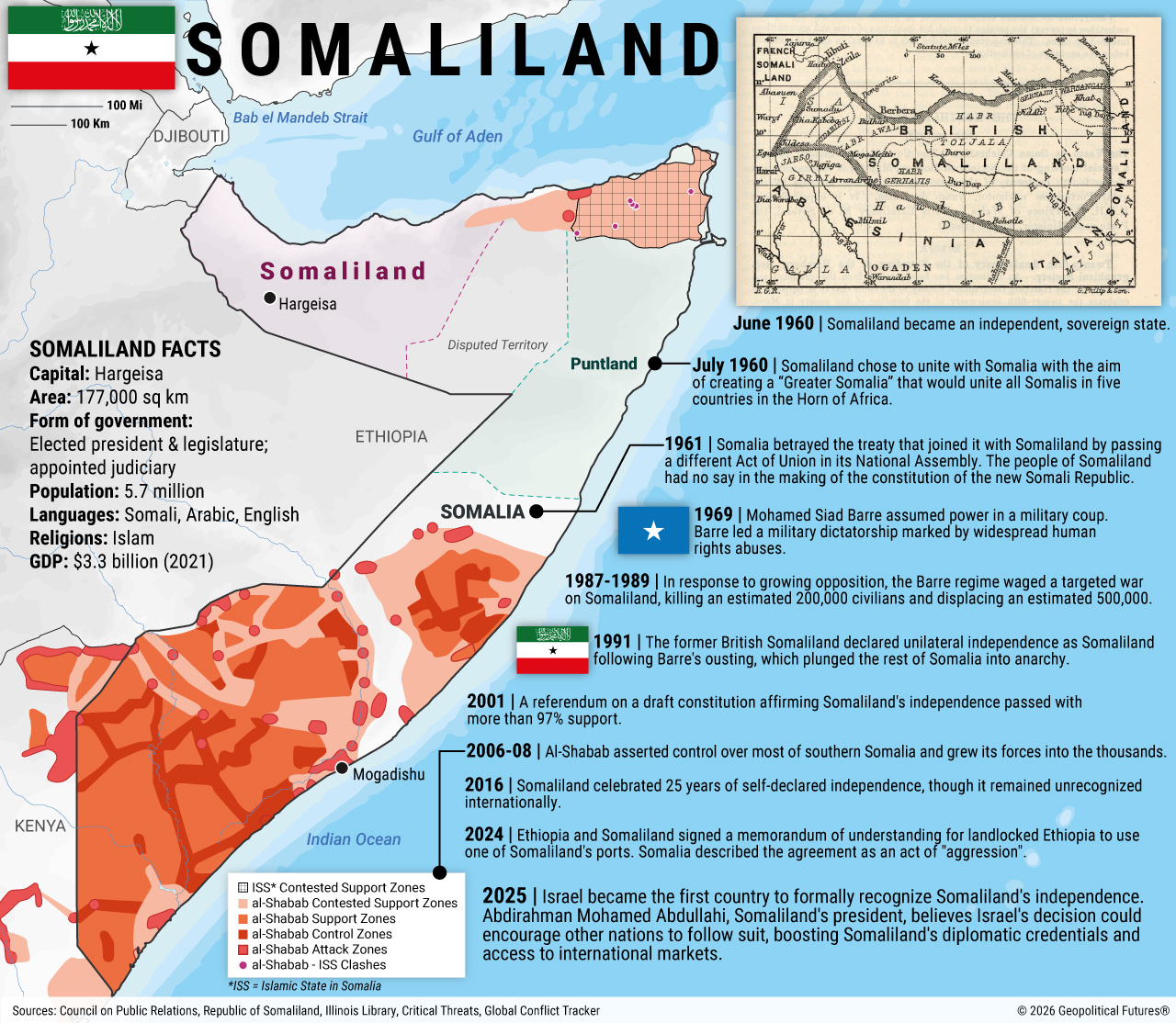
More than three decades after Somaliland claimed independence from Somalia, Israel became the first country to recognize its separation. It was a long road to get here. In the 19th century, the land that is now Somaliland was colonized by Britain, while Italy controlled the rest of Somali territory. Somaliland then briefly declared independence in 1960 during the wave of decolonization, before uniting with Somalia as the Somali Republic. In 1981, militias from Somaliland coalesced to form the Somali National Movement and fight the oppressive government in Mogadishu led by Gen. Mohamed Siad Barre. The Somaliland Independence War ended in 1991 when Barre’s regime fell and the SNM declared the unilateral secession of the Republic of Somaliland.
Since that time, however, Somaliland has failed to win international recognition, despite its political stability relative to Somalia. In January 2024, Ethiopia signed a long-term lease agreement for port development with officials from Somaliland, apparently in exchange for recognition of the territory, but Addis Ababa backtracked following criticism from other African countries. The UAE has also invested significantly in the territory and uses it as part of its logistics network in the Horn of Africa.
For Israel, Somaliland offers an opportunity to complicate Turkey’s strategy in Somalia, and its territory could even be used to strike Houthi targets across the Red Sea in Yemen. Other countries, including the U.K. and U.S., may also recognize Somaliland’s independence, given the territory’s strategically valuable location and relative stability.