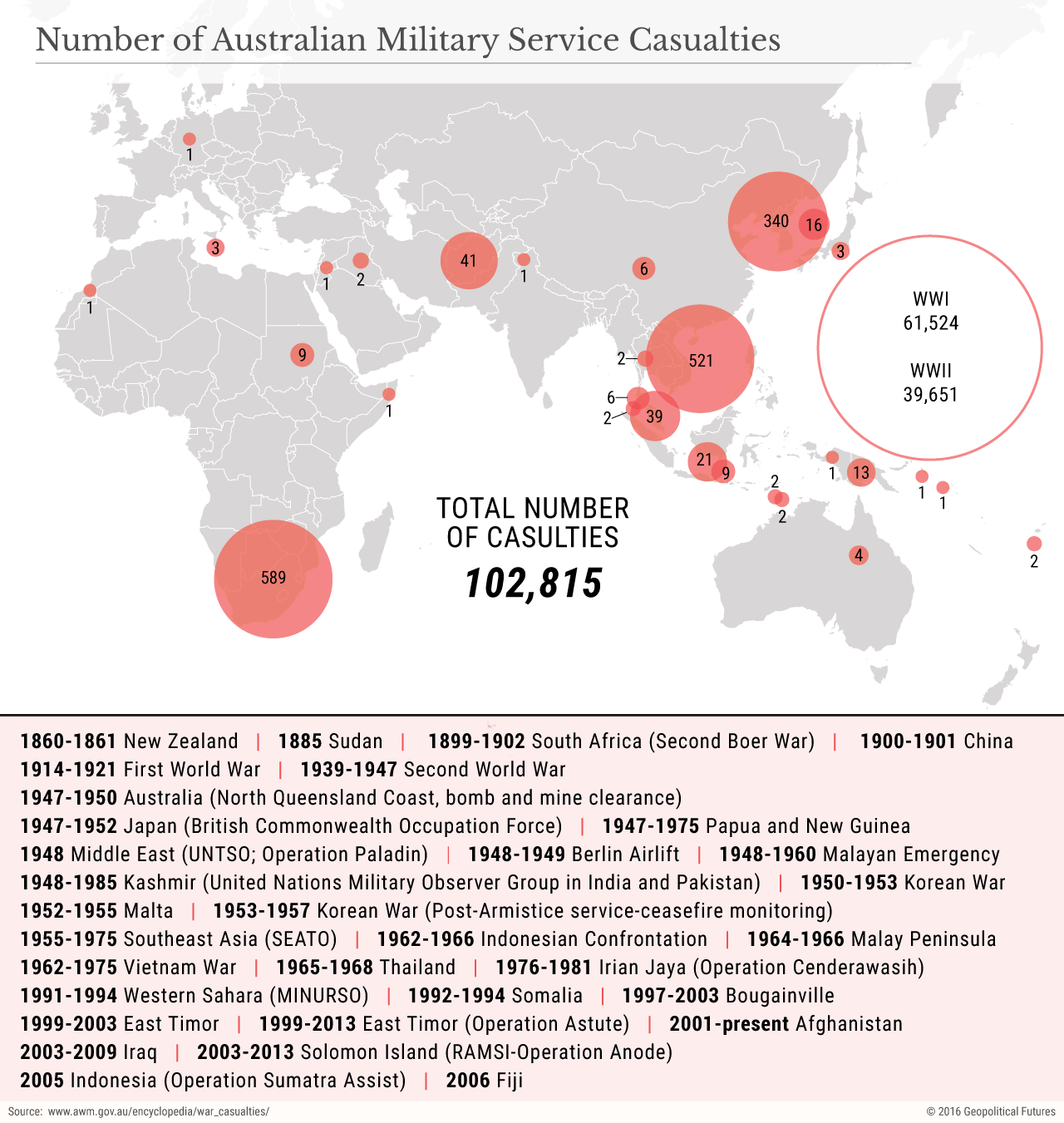
Australian Military Service Casualties

Feb. 2, 2016 This map indicates the number of casualties the Australian military has suffered in various conflicts, mostly outside of the country’s own borders. Especially significant was Australia’s participation in World War I. This was to be a major turning point in defining Australia’s identity as a nation for two key reasons. The first is that the new Australian navy proved to be a formidable force and the country could now safely say that its first three strategic imperatives had been achieved without any doubt.

The second is that World War I marked the moment in history where the interests of Australia and the British Empire would diverge and this split would be irrevocable. Australia’s population was approximately 4.9 million during the war and over 450,000 Australians enlisted, equivalent to 38.7 percent of males between the ages of 18 and 44, according to Australian historian Ernest Scott. Of those enlisted, about 60,000 died. Moreover, the Gallipoli Campaign, a battle in 1915 in present-day Turkey that claimed 8,000 Australian lives, in hindsight was a paradigm-shifting moment for Australia. The perceived needlessness for which Australians died at Gallipoli led to the conclusion that, while Australia would choose to go to war many more times in the future, it would do so to defend Australia and not simply out of loyalty to Great Britain.


To read more about Australia’s strategy toward securing its most pivotal national goals, read our Net Assessment of Australia.




Related Articles

  • Geography of Central Asia

    April 6, 2016 This week’s graphic shows the geography of the Central Asian states, as well as the distribution of various ethnic groups. Centuries of invasions and foreign rule contributed to the emergence of weak states with deep internal vulnerabilities in Central Asia. We have discussed how Europeans, through the 1916 Sykes-Picot Agreement, created artificial borders in the Middle East, thus laying the groundwork for the disintegration of Syria and Iraq that we are seeing today. Central Asia’s modern-day borders were also drawn by outsiders, though in this case it was Soviet planners in the 1920s and 1930s. Today’s borders are thus not organic and do not strictly reflect ethnic or national divisions. About 23 percent of Kazakhstan’s population, for example, is made up of ethnic Russians. Ethnic Uzbeks make up about 14 percent of Kyrgyzstan’s population and over 13 percent of Tajikistan’s. Central Asia is thus a region where ethnic and regional tensions abound and threaten the unity of the modern states.

    Keep reading
  • North Korea at Night

    March 29, 2016 This week’s graphic shows the lights on the Korean Peninsula that are visible from space at night, which illustrates the cost of North Korea’s strategic irrationality. Rationally speaking, North Korea couldn’t possibly launch a nuclear strike. Therefore, it is critical for North Korea to appear irrational. South Korea, China and the U.S. understand North Korea well enough to endure its assertions of power and aggression without panicking. The regime appears resilient and in control. The result is a formula for stalemate… a stalemate of the indifferent. But the cost of this stalemate is the blackness of the North Korean night. The cost of maintaining the regime is a dramatic lack of economic development. Whatever wealth exists is diverted to maintaining the bluff, which in turn requires a delicate internal balance that demands not only massive repression but also, above all, isolation.

    Keep reading
  • Islamic State Attacks in Belgium

    March 22, 2016 This week’s graphic shows the location of each explosion in Brussels and where Paris attack suspect Salah Abdeslam was arrested. Attacks like those in Brussels today, especially on soft targets like large, unprotected public transportation centers, are likely the new normal for Europe. The Islamic State is largely focused on its war in Syria and Iraq, but militants have shown a willingness to further some strategic goals through terror attacks farther afield. It is in the group’s interest to strike visible Western targets because it benefits when the tide of popular opinion turns against migrants and when Muslim minorities in Europe feel that the West does not accept them. Moreover, it is impossible for authorities to fully secure all soft targets. Even if some members of a cell are arrested or killed, groups tend to have middle managers who are responsible for coordinating multiple cells.

    Keep reading

Geopolitical Futures tells you what matters and what doesn’t.

People say you can’t predict geopolitics.

We have.

Subscribe Here
Site Licences click Here