

Geographically, Israel is in a profoundly weak strategic position. At its widest point, it is only 71 miles (114 kilometers) across; at its narrowest point, it is only nine miles across. Israel has no defensive space. It has little ability to withdraw, regroup and counterattack. Defensive depth is essential to national security. It determines how much time there is to recover from an initial attack. Space and time are essential to war.
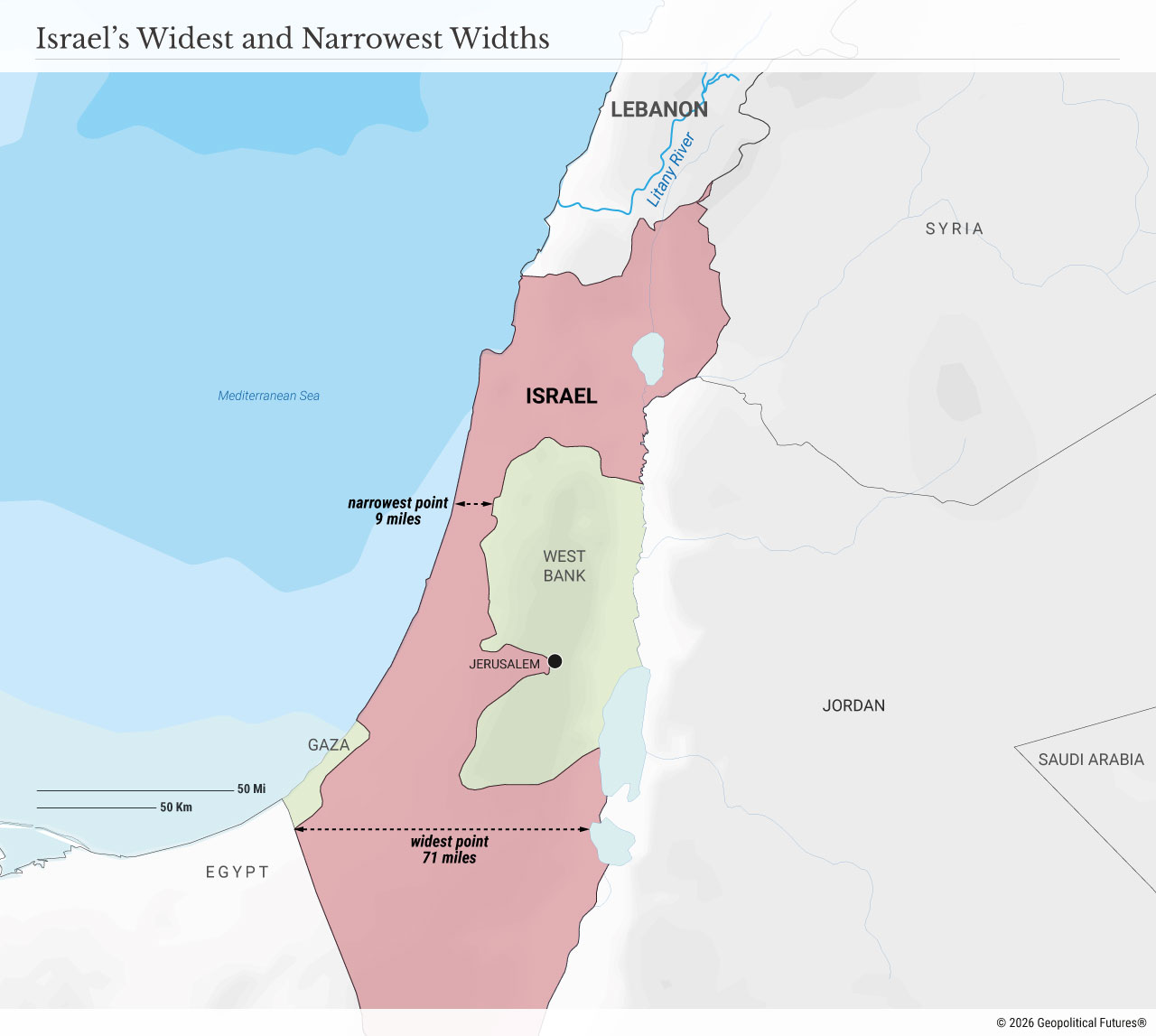
Ignoring the emergence of drones, Israel cannot tolerate a defeat at its border, because a defeat would give it, at most, 71 miles in which to retreat. From this flows a specific military logic. Israel has to prevent attacks by initiating combat, and it has to be able to defeat its enemy early in a war. For Israeli leaders, it follows that the Israel Defense Forces always have to be significantly more powerful than potential enemies. The idea that Israel would never face a force more powerful than its own has always been improbable. During the 1973 attack by Egypt and Syria (which were armed and coordinated by the Soviet Union), Israel came perilously close to disaster. It was saved by the fact that Egyptian, Syrian and Soviet planners had failed to anticipate their dramatic early successes and had no plans to fully defeat Israel and seize its land.
At the time, the reality of the Middle East was that the Soviet alliance with Egypt and Syria threatened not only Israel but also pro-Western nations. In 1956, Egypt took control of the Suez Canal, encouraged as it was by Moscow, creating a fundamental crisis for the United States, which feared that a British and Israeli counterattack on Egypt and Syria would lock the Soviets into the region. To a degree, it limited Soviet power – Moscow would have preferred an attack on two Arab countries – but it also created a long-standing situation in which Russia had a powerful hand in the region. This was the basis of the U.S. relationship with Israel, as well as other Middle Eastern countries. Until the Soviet Union collapsed and Russian power faded, Israel was the tool the United States used to intimidate Egypt and Syria.
Israel won the 1973 war partly because of U.S. help, which, again, was predicated on Cold War military logic. But this did not solve Israel’s fundamental strategic dilemma. Its strategic depth and ability to maneuver remained limited. The U.S.-Israeli alliance was still intact, and Israel continued to be a major power in the region and a U.S. ally. The peace treaty Israel signed with Egypt in 1978 brought an end to 30 years of conflict between Israel and Arab states. After that, the greatest threats Israel faced came from non-state actors, most of which were supported by Iran. That changed in 2023, when Israel decimated Iranian capabilities and the capabilities of its proxies like Hezbollah in response to the Oct. 7 Hamas attack. Israel’s response also contributed to the downfall of the Assad regime in Syria, which returned Israel to a state of war against states.
Israel found that it needed greater strategic depth not only to survive a conventional war but also to limit access to Israel by non-state actors. The attack on Gaza and the treatment of Gazans there were triggered by this fear, as was the decision to occupy the West Bank and to effectively bring Israel’s border with Lebanon up to the Litani River.
The problem with Israel’s actions is twofold. First, the amount of land seized as buffers is still not enough to eliminate the threat posed by non-state actors like Hezbollah or conventional state militaries, especially as new weapons and yet-to-be-invented weapons cast doubt on whether the Israel Defense Forces will always be the superior military. Nor can the land seized guarantee a permanent U.S. commitment to Israel, just as Israel overestimated the capabilities of its intelligence services.
What follows is, I think, predictable. Political leaders believe that a relatively small increase in space and force will reduce Israeli vulnerabilities. But there’s no guarantee that the IDF will always be the superior military, nor that the U.S. will always be an ally. Israel, like the Europeans, may comfort itself in assuming the U.S. has a geopolitical and moral obligation to defend it, allowing it to go on as it wills. This is a matter not of who is president but rather of fundamental national interest. The U.S.-Israeli relationship was based on the realities of the Cold War. But the Cold War is over, and national interests change.
It is thus in the interest of Israel to reach an understanding with regional powers, many as intimidated by Hezbollah and the like as Israel is. President Donald Trump’s suggestion of using the Abraham Accords is not likely to happen. But neither is Israel’s strategy of permanently using force to protect itself likely to succeed. Israel is a small country with a stronger military than others in the region, but military balances shift. The fact that Israel is vulnerable will not. But given that nations tend to do what they must, Israel’s internal political system must evolve to take into account what I see as not possible but probable: an evolution of power over time in other nations of the region. There are risks in seeking accommodation, but in the long term, not doing so is betting on perpetual division and the military weakness of others. I see this latter choice as the more dangerous one.



 The World Explained in Maps