

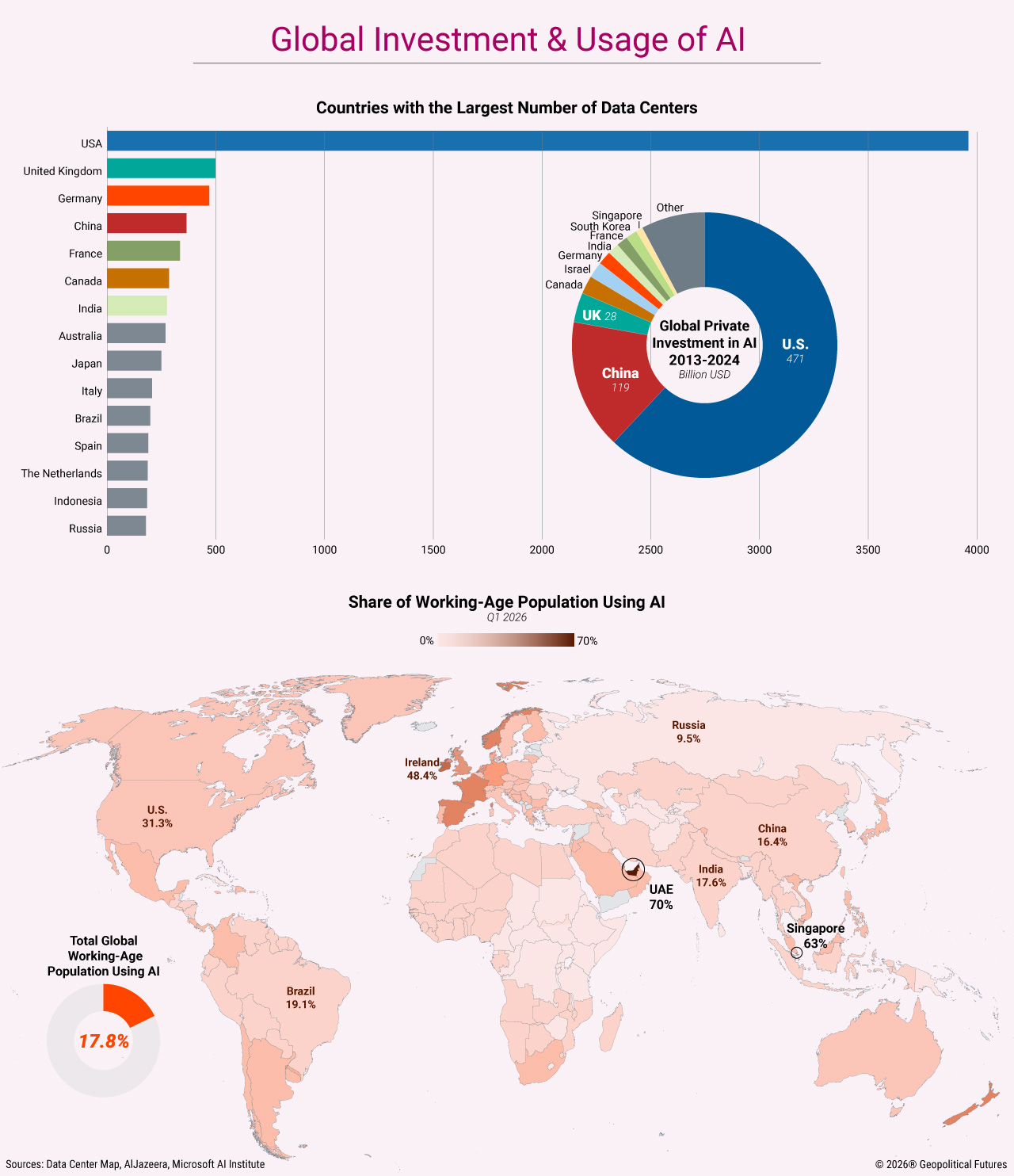
The global race to build data centers has become a competition for AI leadership, with countries pursuing different but complementary strategies. The United States remains the dominant force, leveraging its AI firms, cloud providers and capital markets to build infrastructure at unprecedented scale, while China is mobilizing state resources to expand domestic compute capacity and reduce dependence on foreign technology. Europe is investing in data centers and AI “gigafactories” to strengthen digital sovereignty, while Canada, Australia and the Nordic region are attracting investment through abundant energy resources and favorable operating conditions. Japan is integrating data center expansion with broader semiconductor and technology initiatives, India is emerging as one of the world’s fastest-growing data center markets due to rapid digitization and a vast domestic consumer base, and Brazil is positioning itself as Latin America’s leading digital infrastructure hub. Russia, meanwhile, is focused on building domestic capacity to support technological autonomy despite constraints imposed by sanctions and limited access to advanced technologies. Collectively, these efforts reflect a new geopolitical reality: Access to compute, power and digital infrastructure is becoming as strategically important in the AI era as access to oil, industrial capacity and transportation networks was in earlier periods.
The Great Data Center Race
Access to compute, power and digital infrastructure is critical in the AI era.


 The World Explained in Maps