

By Andrew Ryvkin
For over a century, Chechnya has been Russia’s most volatile republic. Rumored to be terminally ill, its leader, Ramzan Kadyrov, who built Chechnya’s power structure around himself, doesn’t have a clear successor. The problem is that for President Vladimir Putin, a failed transition would threaten one of the central claims of his rule: that Russia won the Chechen war. If the republic destabilizes, Moscow will have to divert significant military, intelligence and security resources to the North Caucasus, even as those resources are already strained by the war in Ukraine. A crisis in Chechnya would almost certainly spread into neighboring Dagestan and may even reach Georgia and Azerbaijan. For the United States, such a crisis could weaken Russia, but it could also destabilize the South Caucasus just as Washington is expanding energy, transport and security projects in the region.
The Chechen Republic is one of Russia’s smallest regions by area and among its poorest. In 2023, the Moscow Times described its gross regional product per capita as the second-lowest in the country, more than four times below the national average.
Politically, however, the North Caucasian republic’s importance to Russia – and to Putin personally – is disproportionate to its size. Control of the North Caucasus is vital to Russia’s strategic interests. The region is essential for maintaining Russia’s reach toward the Black and Caspian seas and protecting Russia’s southern border, especially after Soviet Armenia, Georgia and Azerbaijan gained independence.
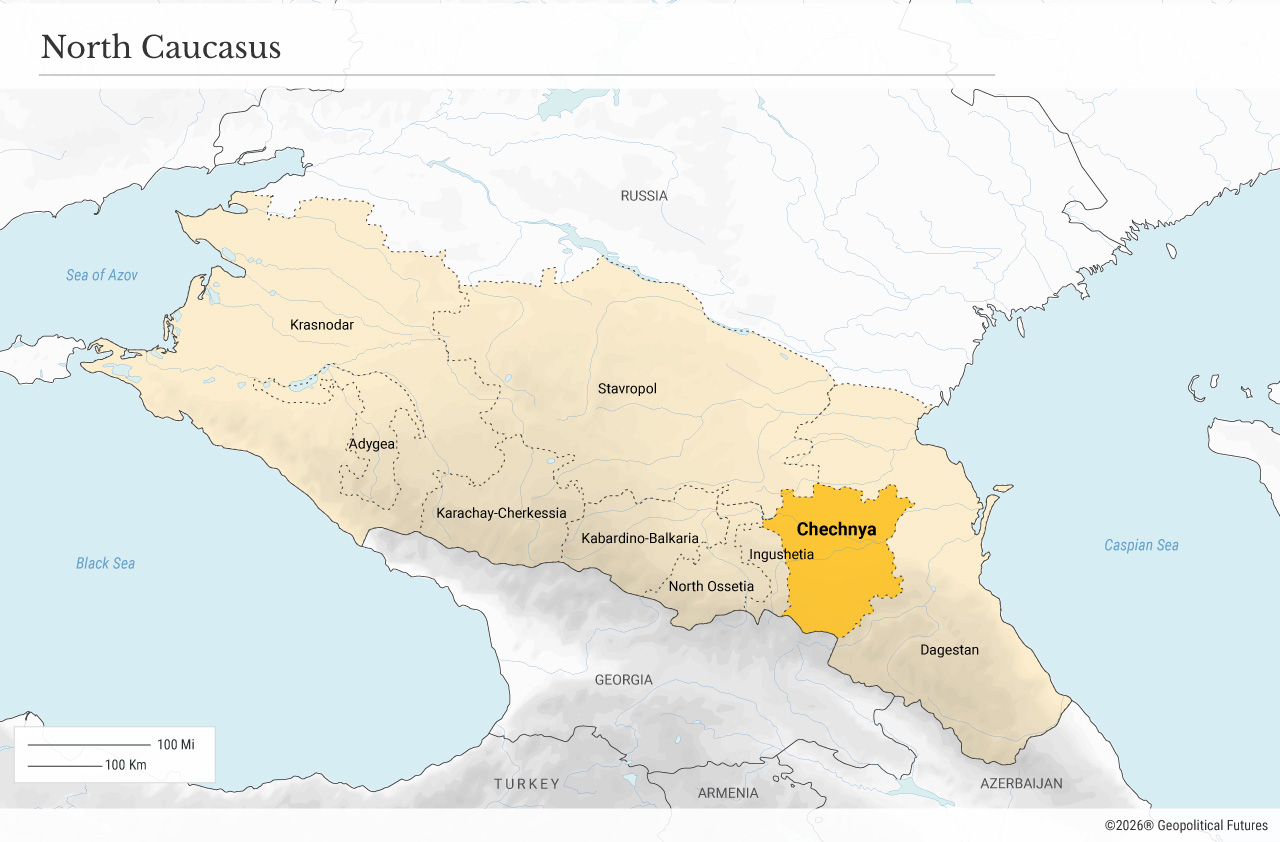
But it’s not just Chechnya’s strategic location that matters to Russia. Chechnya played a pivotal role in Putin’s rise to power. Soon after the Soviet collapse, Chechnya declared independence, which Moscow refused to recognize before invading in 1994 after failed attempts to bring the republic back under Russian control. The war became a humiliation for Moscow: Russian forces suffered catastrophic losses, and in 1996, the Kremlin was forced to sign peace accords with a government it considered illegitimate.
In 1999, when Putin was still prime minister, a series of apartment bombings linked to Chechen separatists killed hundreds of people across Russia. The bombings, along with a Chechen incursion into the neighboring region of Dagestan, gave the Kremlin a mandate for a second military campaign in Chechnya – one that simultaneously became Putin’s presidential campaign. He positioned himself as a wartime leader who would crush the terrorists and restore Russia’s borders – along with its dignity.
On Dec. 31, 1999, the day Boris Yeltsin resigned and Putin became acting president, Putin flew to Chechnya to visit Russian troops, personally hand out awards and celebrate the turn of the millennium. In a very literal sense, Putin’s presidency was tied to Chechnya from day one. Russia’s invasion of Georgia in 2008, the annexation of Crimea and the full-scale invasion of Ukraine later expanded his legacy, but it was Chechnya that created it. A destabilization in Chechnya wouldn’t merely create a regional security problem; it would threaten Putin’s original claim that he brought Russia back from the chaos of the 1990s.
Since 2004, the republic has been ruled by Kadyrov, Chechnya’s de facto dictator and, as he calls himself, “Putin’s loyal foot soldier.” Kadyrov ruthlessly crushed the Islamist insurgency of the 2000s, destroyed all domestic opposition, killed or co-opted rival clan leaders and turned the once-volatile region into a near-totalitarian state within a state. In doing so, he secured Russia’s victory in the Chechen wars.
In 2022, rumors began circulating that Kadyrov was terminally ill. While his exact condition remains unknown – some outlets have reported pancreatic necrosis – photos and videos suggest a dramatic decline: In just a few years, Kadyrov, now 49, went from an athletic build to walking with a cane. This poses a fundamental problem for the Kremlin. Kadyrov, whose power in Chechnya is near-absolute, has no obvious successor, and there is no guarantee that whoever replaces him will be able to keep the region, or Putin’s legacy, from unraveling.
In contrast to Russia’s other regions, the relationship between Moscow and Grozny is tied almost entirely to the relationship between Putin and Kadyrov. It rests on a simple bargain: massive subsidies and autonomy in exchange for unwavering loyalty and stability. Formally, Chechnya’s prime minister is supposed to take Kadyrov’s place if he dies. Kadyrov’s departure, however, could unravel the entire informal system that allowed Putin to claim he had solved the Chechen problem without ever truly reintegrating the republic into the Russian Federation.
In Chechnya, Kadyrov controls a vast security apparatus whose members are formally embedded in Russian state structures but are widely understood to answer first to Grozny. Around this force, he has built a system governed through the cult of his late father, Akhmat, and himself, informal commands, Islam, public rituals of obedience, and collective punishment. Public behavior is regulated through Sharia norms and local traditions. Women are expected to dress according to Islamic tradition, polygamy is informally practiced, and human rights groups have reported honor killings, though both polygamy and murder are illegal under Russian law. Kadyrov’s power also extends beyond Chechnya’s borders, with his forces permitted to intimidate, abduct or return those who fled the republic.
Over the past few years, Kadyrov filled numerous government posts with members of his family with a clear aim to create a ruling dynasty. His sons have been given titles, ministries and security roles that would normally require experience they lack. In 2025, it was widely believed that Kadyrov’s choice of successor was his son, Adam, who was still a teenager. He was elevated to head of Chechnya’s security council.
But in January 2026, Adam was injured in a serious car crash in Grozny. After the accident, Novaya Gazeta Europe reported that Adam had been “clearly downgraded” and was no longer Kadyrov’s main potential successor. The role of favored son appeared to shift to his brother, Akhmat Kadyrov Jr., who has increasingly accompanied his father at important meetings despite being barely into adulthood.
Picking a successor from among his children is a logical move for Ramzan Kadyrov, but the position of the Russian security services may differ. They are loyal to Putin, as well as what they see as the interests of the Russian state beyond its current leader. From the perspective of the Russian security establishment, a Russian region becoming a de facto Islamic sultanate ruled by a dynasty whose members don’t have a decades-long relationship with the Russian leader would be an immense danger to the country.
Some signs point to Moscow grooming Apti Alaudinov, the media-savvy commander of the Chechen forces in Ukraine, as a possible successor. He helped negotiate the transfer of Wagner remnants into the Chechen special operations forces fighting in Ukraine, became a Hero of Russia recipient for his role in the war and was appointed to a senior post in the Russian Ministry of Defense. Unlike Kadyrov’s sons, Alaudinov offers Moscow a different profile: In contrast to members of the Kadyrov clan and the Chechen leader’s inner circle, Alaudinov speaks Russian without an accent and maintains an image of a battlefield commander, not a warlord, making his public style legible to the Russian audience.
If Kadyrov is indeed terminally ill, it may be the first time his interests and Putin’s are unaligned. Kadyrov’s priority would be securing the safety of his clan, its position in Chechnya, and its vast financial resources. Putin, on the other hand, has to keep Chechnya stable and firmly under Russian control – even if that means removing the Kadyrov clan to prevent destabilization.
With his focus on Ukraine, Putin has largely ignored Chechnya, trusting Kadyrov to keep the republic in line. Kadyrov’s health, however, forced Putin to involve himself more in the region, including tentatively endorsing Kadyrov for re-election and meeting his children.
Paradoxically, Putin has less room for maneuver in Chechnya than in Ukraine. Even without defeating Kyiv, Russia can still negotiate, prolong the fighting or simply declare victory. Chechnya ultimately offers the Kremlin two options: Either it remains a stable Russian republic, or it becomes a volatile mountainous region marked by armed Islamist factions, clan rivalries and centuries of resentment toward Moscow’s rule.
Andrew Ryvkin is a journalist and analyst who writes for Air Mail and The Atlantic on Russia and U.S.-Russia relations. He previously worked in Russian politics and media, and has lectured at universities including Harvard and Yale on the Kremlin’s political messaging.


 The World Explained in Maps