

That the United States is engaged in high-stakes negotiations with China, Russia and Iran – all at the same time – is a rare geopolitical situation. Put simply, U.S. diplomacy is heading toward a crescendo in which timing, sequencing and cross-theater signaling will shape outcomes as much as the substance of any single deal. Each party faces distinct but tight constraints that compel them toward an inflection point. As a result, they are more likely to pursue compartmentalized accommodations with the White House that secure immediate interests, even at the expense of the other two. Crucially, it underscores that contrary to conventional wisdom, these three countries do not constitute an effective anti-U.S. bloc.
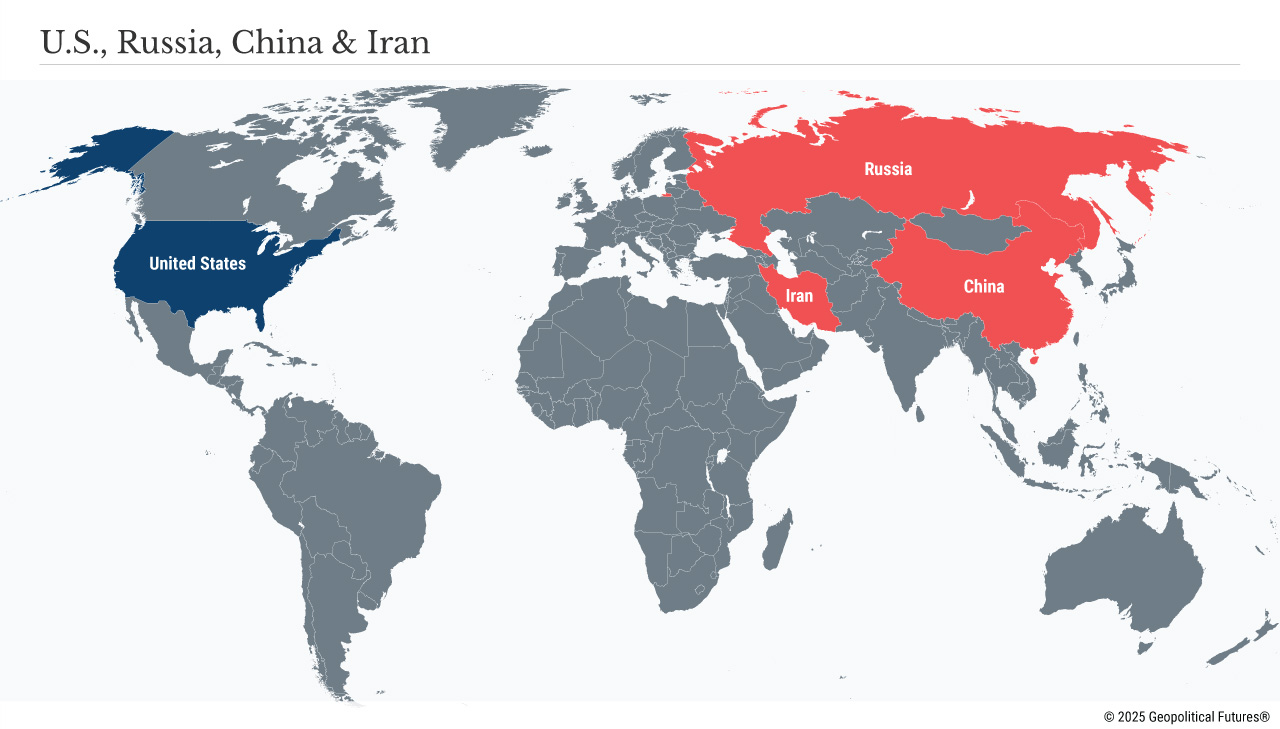
The past week has been rife with American diplomatic activity. On May 4, U.S. Treasury Secretary Scott Bessent said presidents Donald Trump and Xi Jinping have discussed Iran and will continue to do so at their summit in Beijing on May 14. Hovering over those talks is the preservation of U.S.-China ties as established by the October trade truce. Elsewhere, the U.S. launched an operation to guide commercial vessels through the Strait of Hormuz, prompting Iran to send boats and fire missiles and drones – none of which hit their targets – while U.S. forces destroyed six Iranian boats, according to CENTCOM commander Adm. Brad Cooper. According to Iranian state-linked media, the Iranian Foreign Ministry has received Washington’s response to its latest peace proposal (delivered via Pakistan) and is now reviewing it. Meanwhile, Trump spoke with Russian President Vladimir Putin last week to discuss a ceasefire in Ukraine and the situation in Iran.
Last November, I argued that China, Russia and Iran all face structural constraints that make some level of accommodation with the U.S. increasingly necessary to advance their core geopolitical objectives. China depends on access to U.S. markets, technology and financial systems to sustain growth, even as its military ambitions in Asia remain constrained by U.S. alliances and forward presence. Russia remains heavily dependent on relief from U.S.-led sanctions and external support for Ukraine, while its economy and global position continue to erode despite partial reorientation toward alternative partners. Iran faces the most acute pressures as economic fragility, regional setbacks and regime security concerns conspire to make some form of understanding with Washington an existential requirement.
Six months later, all three of these U.S. adversaries are being forced to negotiate with the Trump administration. Iran’s situation is obviously the most delicate, especially in light of the conflict with the U.S. and Israel. Deteriorating economic conditions in Russia have forced Moscow to reach out to Washington to try to reach a settlement on Ukraine that could provide it with much-needed relief. China needs to reach an accommodation with the U.S. to deal with an economy under mounting strain from a prolonged property sector downturn, structurally slower growth, rising youth unemployment and heavy local government debt burdens.
Russia’s situation is perhaps the most notable. A signal of his interest in expanding geoeconomic engagement, Putin has now reached out to Trump – a shift driven by intensifying economic strain, including sustained sanctions pressure, limited access to global finance and technology, war-related fiscal burdens and a greater dependence on a narrower set of external partners. At the same time, Moscow recognizes that it’s losing its leverage with Washington amid the weakening of Iran and the Kremlin’s limited capacity to project meaningful support across other theaters. Most important, the prospect of a broader U.S.-China accommodation heightens Russian incentives to rethink its options because it would further marginalize Moscow and accelerate declining influence.
Beijing’s interest in the upcoming summit and in a broader accommodation with Washington reflects a pragmatic assessment of growing structural constraints. China remains heavily dependent on access to U.S. markets, advanced technology and financial systems to sustain growth. Escalating U.S. restrictions on semiconductors, AI and advanced manufacturing inputs are tightening bottlenecks on China’s long-term industrial ambitions. In this context, engagement with Washington is less about strategic convergence than about managing constraints; it wants tactical relief, stable expectations and more room to maneuver in an increasingly adverse external environment.
Iran, meanwhile, is facing an existential crisis. Its imperative toward regime preservation is more important than ever before. To that end, it needs not just an end to permanent hostilities but also sanctions relief. It may be projecting an image around the world that it is capable of shutting down commercial traffic through the Strait of Hormuz, but it knows doing so is unsustainable.
Tehran also realizes Russia and China have their own dealings with Washington that, for them, are more important and thus can offer little help. If anything, Tehran knows that Beijing and Moscow are likely to assist Washington in extracting concessions that are far more important to them than they are to Iran. For Russia, the goal is to avoid a political-economic crisis at home and to prevent the gap between its economic output and China’s from becoming even larger – which would likely happen as a result of an understanding with the United States. China’s national security imperatives linked to a growing economy are such that it would be willing to work with the U.S. on both the Iranian and the Russian fronts.
In this emerging configuration, the White House’s differentiated approaches to China, Russia and Iran underscore a broader geostrategic shift toward managing adversaries on their own terms rather than approaching them as a cohesive bloc. By exploiting the distinct vulnerabilities, priorities and negotiating imperatives of each, Washington is able to exploit the incoherence of this anti-U.S. alignment. This approach highlights the structural limits of coordination among the three, whose interests increasingly diverge under the weight of domestic constraints and external pressures. The U.S., then, is able not merely to contain but also to selectively neutralize the most acute threats posed by each, parlaying their incoherence into a strategic advantage.



 The World Explained in Maps