

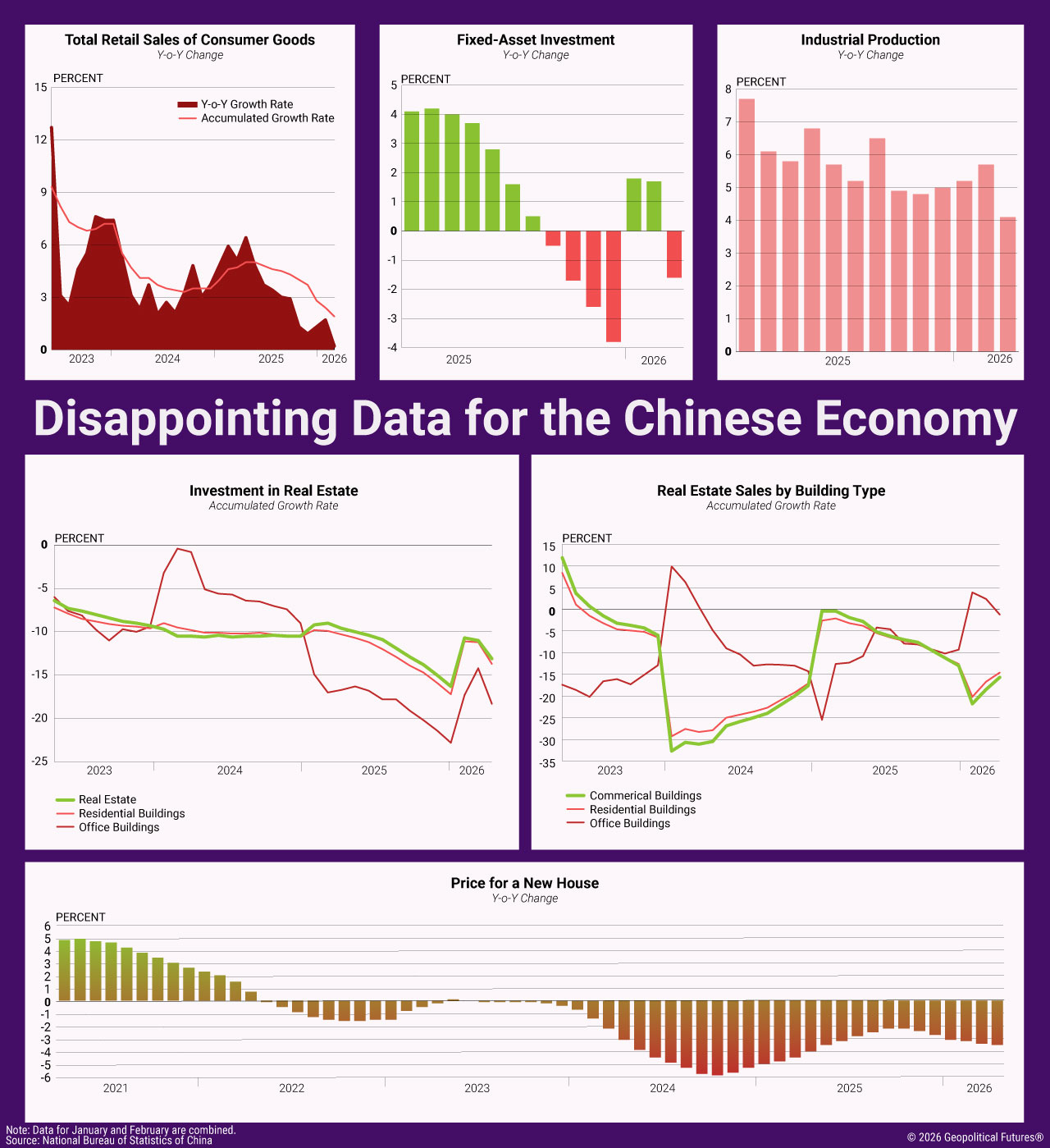
China’s economy continues to face a difficult balance as weak domestic demand, a prolonged property downturn and external geopolitical risks weigh on confidence. While the leadership has emphasized “high-quality growth” and targeted support for strategic industries, recent data reinforces concerns that consumer sentiment and private-sector investment remain subdued. Persistent deflationary pressures and high youth unemployment also signal that households and businesses are still cautious about spending and expansion. Escalating tensions in the Middle East could further complicate China’s recovery by increasing trade uncertainty and input costs. One bright spot is that China’s export sector has remained resilient, with stronger overseas demand helping offset some of the weakness in domestic consumption and property markets.
At the same time, Beijing appears reluctant to launch another large-scale stimulus campaign similar to those implemented after previous slowdowns. Instead, authorities have favored incremental policy support, selective infrastructure spending and targeted credit measures aimed at stabilizing growth without significantly increasing debt risks. This new, more restrained approach reflects concerns over local government debt burdens and the decreasing effectiveness of large-scale stimulus measures. As a result, expectations for China’s medium-term growth outlook have become more cautious, and a rapid rebound seems increasingly unlikely.



 The World Explained in Maps