
HomeRegional DirectoryMiddle East and North Africa

Middle East and North Africa

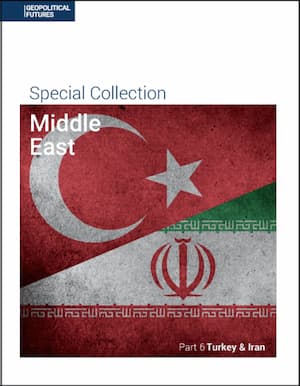
Special Collection on the Middle East

This complete work consists of several dozen essays spread out over 8 parts tackling the region’s conflicts and historical evolution, relating them to contemporary issues. Divided into distinct regions and critical issues, the Special Collection of the Middle East is your source to better understand this volatile region and to be prepared for what comes next.

The Gulf Cooperation Council’s Security Dilemma

In 1981, six Arab countries bordering the Persian Gulf established the Gulf Cooperation Council to counter the threat posed by Iran and Iraq, their...

A Critical Point in the Iran War

After three months, the war in Iran has reached a critical point. The conflict itself has become frozen in a way. The Islamic Revolutionary...

The Diffusion of Technology Is Changing Warfare

For decades, modern force projection depended on the assumption that rear areas could be secured against most forms of disruption. As a result, forces...

Turkey’s Turkic Strategy Meets Eurasian Constraints

The United States continues to pursue a strategy of offloading security responsibilities to regional partners. Implicit in that strategy is the expectation that these...

Prospects for a New Middle East Order

After the fall of Saddam Hussein’s regime in 2003, a new Middle East order began emerging, defined by a precarious balance among Iran, Turkey,...

Denial Vs. Control in the Strait of Hormuz

The debate surrounding the Strait of Hormuz tends to overlook a fairly obvious fact. Recent attacks and continued vessel movement through the strait show...

Ship Traffic Around Southern Africa Resurges

FREE
(click to enlarge) Tanker traffic around the Cape of Good Hope has surged to its highest levels since early 2025 as conflict in the Middle...

What the UAE’s OPEC Exit Means for the Global Energy Market

The United Arab Emirates’ decision to leave OPEC, effective May 1, was not an isolated policy shift but the culmination of a deeper, decade-long...

America’s Simultaneous Management of China, Russia and Iran

That the United States is engaged in high-stakes negotiations with China, Russia and Iran – all at the same time – is a rare...

Daily Memo: European Leaders Gather in Yerevan

Partners abroad. European leaders are gathering on Monday for a summit of the European Political Community, a forum created in 2022 at the initiative...

George Answers Your Questions: The Iran War and How It Ends

The Iran War and How It Might End April 27, 2026 Question: The IRGC is dependent on money from oil sales and supplies from China. If...

Global Economic Trends

(click to enlarge) Though global economic growth has stabilized since the 2020 pandemic meltdown, it remains below pre-pandemic averages and unevenly distributed across regions. After...

What Kind of Regime Will Emerge From the Iran War?

The biggest question raised by the war in Iran is not how the conflict ends but what kind of regime ultimately emerges in Tehran....

Turkey’s Ascent From Dependence to Autonomy

Situated at the intersection of the Black Sea, the eastern Mediterranean and the Middle East, Turkey occupies some of the most strategically valuable land...

A Century of Lebanese-Israeli Talks Without Peace

For a century, Lebanese-Israeli negotiations have failed to bring about peace. Since its founding in 1920, Lebanon has refused to recognize Israel or support...

The Iran War and How It Might End

FREE
The U.S.-Israel war against Iran was to a great extent predictable. The United States feared Iran becoming a nuclear power. Israel feared that as...

Latest Posts

The meltdown of autocratic regimes currently underway in the Arab world has led to the growth of ungoverned spaces. The resulting vacuum is being dominated by armed Islamist non-state actors – in particular Salafist-jihadist militias.

The three non-Arab powers – Turkey, Iran and Israel – are trying to manage the regional commotion according to their national interests.

It was during the Cold War era that a deep ideological chasm in the Middle East began to coagulate. The struggle between those who adopted European secularism and those who crafted an ideology based on religious tradition had its roots in late 19th century Ottoman Empire. Roughly 100 years later, this struggle had polarized the region.
Read Regional Assessment

Read Assessment of Saudi Arabia

Read Assessment of Turkey

From our Forecast...

The Vienna nuclear talks will result in a settlement. The Israeli Air Force will not attack Iran’s nuclear sites.

Middle East and North Africa in our Memos

Continue to the category

More from the Middle East and North Africa

Continue to the category

Latest Posts

Colombia’s Presidential Race

FREE
(click to enlarge) Colombia will hold presidential elections on May 31, with a runoff on June 21 if no candidate wins an outright majority. The...

For the Quad, Flexibility Is Not Weakness

The most recent Quad foreign ministers’ meeting in New Delhi was more productive than usual. The four members – the United States, Japan, India...

Daily Memo: US and Iran Near Ceasefire Extension

Getting closer. U.S. and Iranian negotiators have agreed to a memorandum of understanding to extend the ceasefire between the two countries, Axios reported. The...