
HomeRegional DirectoryMiddle East and North Africa

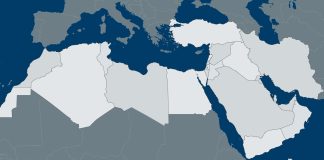
Middle East and North Africa

Special Collection on the Middle East

This complete work consists of several dozen essays spread out over 8 parts tackling the region’s conflicts and historical evolution, relating them to contemporary issues. Divided into distinct regions and critical issues, the Special Collection of the Middle East is your source to better understand this volatile region and to be prepared for what comes next.
Iran: Elite Paralysis and Systemic Decay

With the 47th anniversary of its founding just around the corner, the Islamic Republic of Iran is spiraling deeper into systemic instability. Ayatollah Ali...

Egyptian National Security, According to el-Sissi

President Gamal Abdel Nasser defined the concept of Egyptian national security in the 1950s, linking it to economic development, social justice, Arab unity and...

The New Maritime Operating Environment

A year ago, we argued that maritime insecurity risked becoming as destabilizing as land-based conflict. Today, that warning largely holds, and in some ways...

Israel Recognizes Somaliland’s Independence

FREE
(click to enlarge) More than three decades after Somaliland claimed independence from Somalia, Israel became the first country to recognize its separation. It was a...

New Normals in the Middle East

The Middle East is entering a period of strategic adjustment as the United States offloads some of its responsibilities to regional allies. The region’s...

The Military Benefits of Quantum Technology

Modern militaries increasingly depend on the continuous functioning of complex systems rather than on decisive battlefield victories. Military advantages, then, are created less by...

The Enduring Wedge Between Syria and Lebanon

U.S. envoy to Syria and Lebanon Tom Barrack has established himself as a maverick diplomat, issuing bold declarations that have at times angered politicians...

Russia’s Escalation in the Black Sea Has Turkey on Edge

Pressure is building on Ukraine and Russia to end their nearly four-year war, setting off a scramble for leverage that is unnerving some of...

Kazakhstan’s Strategic Breakout: The Abraham Accords as a Route to the High Seas

Kazakhstan’s decision last month to join the Abraham Accords carries strategic implications that extend far beyond efforts to wind down the eight-decade conflict between...

For Israel and Saudi Arabia, Normalization Is No Longer a Priority

During a meeting at the White House on Nov. 18, U.S. President Donald Trump pressured Saudi Crown Prince Mohammed bin Salman to join the...

The US Snubs the Lebanese Army

The Lebanese army is facing increasing pressure from both the U.S. and Israel to strengthen its efforts to disarm Hezbollah. Its lack of progress...

Saudi Arabia’s Burden-Sharing Test

As the most volatile theater in the international system, the Middle East poses the greatest obstacle to President Donald Trump’s effort to operationalize a...

On the Global Gen Z Protests

Over the past few months, a wave of protests led by members of Generation Z has swept over the world. They have largely taken...

George Answers Your Questions: Russia’s Vast Borders, US Intelligence on Drug Smuggling

Russia’s Issues Beyond Ukraine Nov. 11, 2025 Question: Why do you conclude with the statement that Russia has neither the ability nor interest to act on...

Syria, Gaza and the Shifting Middle Eastern Order

Early this week, U.S. President Donald Trump welcomed Syrian President Ahmed al-Sharaa at the White House, signaling Washington’s intention to recast Syria as the...

The UAE’s Role in the Sudanese Civil War

Sudan is an unviable country because it is home to 570 tribes, 57 ethnic groups and nearly 60 separatist movements. Immediately after its independence...

Latest Posts

The meltdown of autocratic regimes currently underway in the Arab world has led to the growth of ungoverned spaces. The resulting vacuum is being dominated by armed Islamist non-state actors – in particular Salafist-jihadist militias.

The three non-Arab powers – Turkey, Iran and Israel – are trying to manage the regional commotion according to their national interests.

It was during the Cold War era that a deep ideological chasm in the Middle East began to coagulate. The struggle between those who adopted European secularism and those who crafted an ideology based on religious tradition had its roots in late 19th century Ottoman Empire. Roughly 100 years later, this struggle had polarized the region.


Read Regional Assessment

Read Assessment of Saudi Arabia

Read Assessment of Turkey

Required Reads: Middle East and North Africa

From our Forecast...

The Vienna nuclear talks will result in a settlement. The Israeli Air Force will not attack Iran’s nuclear sites.

Middle East and North Africa in our Memos

Continue to the category

More from the Middle East and North Africa

Continue to the category

Latest Posts

George Friedman on Why the U.S. Cares About Venezuela, Cuba and Greenland

FREE
With the new U.S. National Security Strategy published by the White House only a month ago, we're already seeing what America's vision for prioritizing the Western Hemisphere looks like. Following America's seizure of Venezuelan President Nicolas Maduro on Saturday, the world is now questioning just how far the US might go to achieve its goal. What are its intentions with Cuba, and how far is it willing to push NATO allies in the issue of Greenland? What are its intentions with Cuba, and how far is it willing to push NATO allies in the issue of Greenland? GPF Chairman George Friedman joins Talking Geopolitics host Christian Smith for our first podcast of the new year, as we dive into what is going on in the Western Hemisphere. You'll also get a sneak peek into our predictions for China, as part of our upcoming 2026 Forecast.

George Friedman on Why the U.S. Cares About Venezuela, Cuba and Greenland

FREE
With the new U.S. National Security Strategy published by the White House only a month ago, we're already seeing what America's vision for prioritizing the Western Hemisphere looks like. Following America's seizure of Venezuelan President Nicolas Maduro on Saturday, the world is now questioning just how far the US might go to achieve its goal. What are its intentions with Cuba, and how far is it willing to push NATO allies in the issue of Greenland? GPF Chairman George Friedman joins Talking Geopolitics host Christian Smith for our first podcast of the new year, as we dive into what is going on in the Western Hemisphere. You'll also get a sneak peek into our predictions for China, as part of our upcoming 2026 Forecast.

Daily Memo: Iranian Protests and Russian Strikes

Targeting Khamenei. On the 12th day of anti-government protests in Iran, demonstrators on Thursday set fire to police vehicles, broadcast buildings, government offices and...

Get Geopolitical Futures FREE newsletter

Understanding Our Geopolitical Model

Sign up now and receive our special report Understanding our Geopolitical Model

Get weekly analysis from New York Times bestselling author George Friedman and our global team of analysts, plus special offers.

Subscription Special


The World Explained in Maps

FREE with an annual subscription to Geopolitical Futures.

Subscribe Now